Should You Pay to Remove 1-Star Reviews? | PR Shield
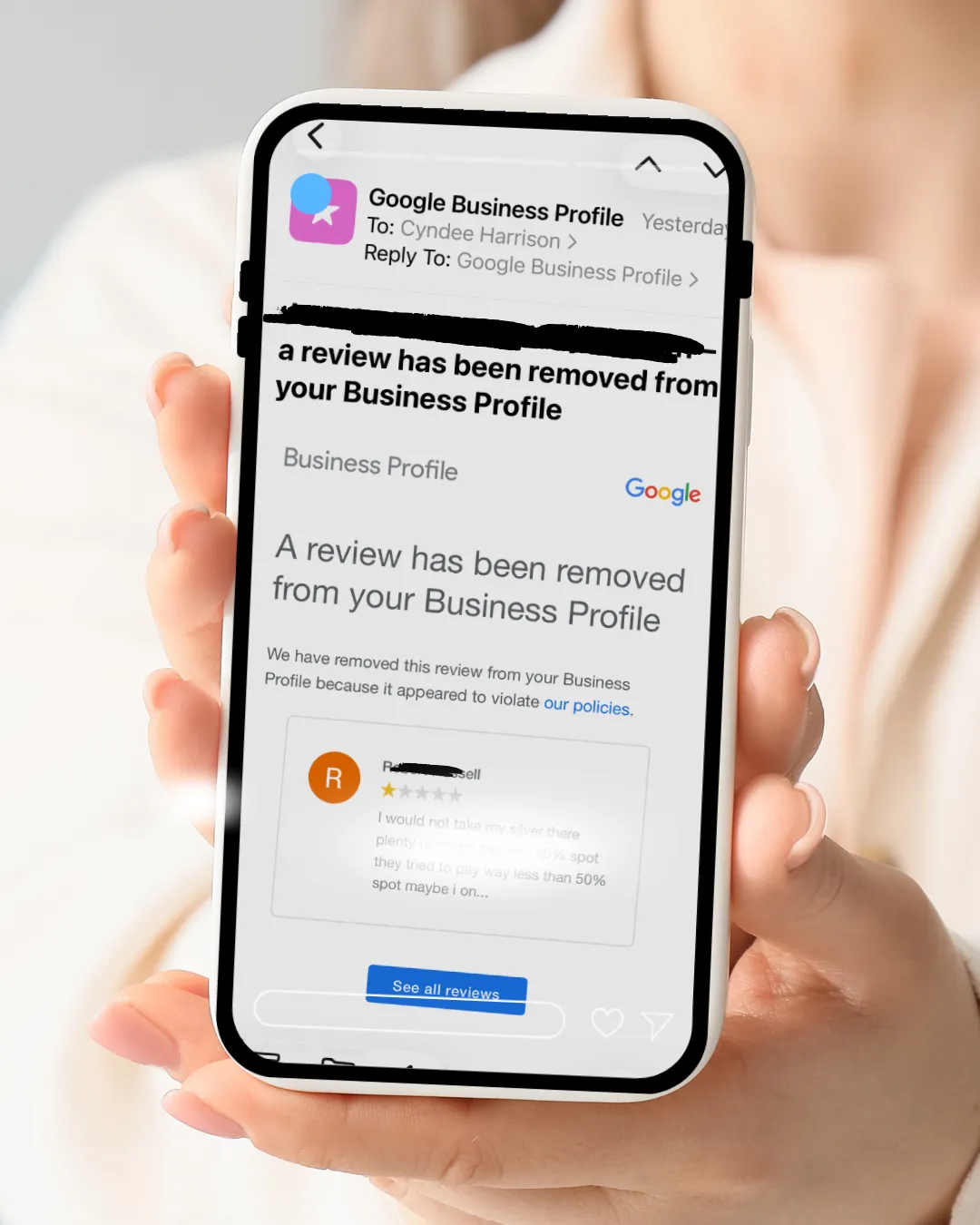
A member of our brand-new community just got a 1-star review taken off their Google listing. Not buried by a sudden spike in new 5-star reviews, but removed by the platform.
This is a a big deal for several reasons, but one is because there’s a whole industry charging business owners a fortune to “make bad reviews disappear,” and I get the temptation because a 1-star review sitting at the top of your listing feels like the end of the world when you’ve poured your heart into what you built. But here’s what those companies won’t tell you: You don’t need a pricey 'reputation repair' package.
There’s a whole industry built on this fear
If you’ve ever had a 1-star review sitting at the top of your Google listing, you know the feeling. You’ve poured your heart into what you built, and one stranger’s bad day is now the first thing every future customer sees. It feels like the end of the world.
There’s an entire industry that exists to prey on exactly that feeling. “Reputation repair.” “Permanent removal.” Five-figure packages that promise to make the bad stuff disappear. And I understand the temptation completely. But here’s what most of those companies won’t tell you: you don’t need a five-figure package. You need someone who thinks like a publicist, not a marketer.
A marketer asks the wrong question
A marketer asks, how do we get more reviews to bury this one? A publicist asks, does this review even belong here — and what does every future customer learn from how we handle it?
That second question is the whole game. With this member, we didn’t fight the review and we didn’t pay to suppress it. We looked at it the way a publicist looks at a story: we checked it against Google’s own policies, found where it crossed a line, and built the case to have it taken down the right way.
I’ll be honest with you, because honesty is the whole brand: that won’t work on every review. Google only removes reviews that actually violate its policies — things like fake reviews, posts from people who were never customers, spam, conflicts of interest, or off-topic rants that have nothing to do with your business. A review that’s simply negative but honest? That one stays, and the answer there is a great response, not a takedown. Knowing the difference — and knowing how to make the case — is the skill most business owners are never taught.
Why “just make it disappear” can blow up in your face
Here’s the part the removal industry really doesn’t want you to know. The shortcuts they sell don’t just waste your money — some of them can land you in serious trouble. Two cautionary tales worth knowing before you ever hand someone your credit card.
1. Burying a bad review with fake ones is now illegal.
In October 2024, the Federal Trade Commission’s Consumer Review Rule took effect. It bans buying or selling fake reviews — and, importantly, it also bans suppressing or hiding honest negative ones. The penalties run more than $50,000 per violation, and in December 2025 the FTC sent its first round of warning letters to companies it believed were breaking the rule. So the classic “marketer move” — drown the bad review under a stack of glowing fakes — isn’t just tacky anymore. It’s the kind of thing that can get you, the business owner, fined. Not the vendor who sold you the package. You.
2. Some “removal” services commit outright fraud — in your name.
This one is genuinely stunning. A few years ago, a UCLA law professor and a Public Citizen attorney uncovered a scheme — later reported by the Washington Post and investigated by CBS News — run by a reputation operator named Richart Ruddie. The playbook: file lawsuits against fake, made-up defendants, forge their signatures agreeing they’d posted “defamatory” content, get a judge to sign a quick consent order, and then hand that court order to Google to force the content to disappear.
Clients reportedly paid $6,000 a month and up. It unraveled into a $71,000 settlement, restitution, a criminal plea, referrals to the FBI, and a court investigation into roughly 60 forged documents. And here’s the chilling part for any business owner: in some cases, the clients knew exactly how it was being done. Imagine paying tens of thousands of dollars to “protect” your reputation, only to end up with your name attached to fraud against a federal court.
If a company promises to make any review vanish, permanently, for a big enough check — that’s not a service. That’s a red flag.
The honest path actually works better
Real reputation work isn’t a magic eraser. It’s knowing the rules well enough to spot a review that genuinely doesn’t belong, making a clean and legitimate case to have it removed, and answering the honest-but-negative ones so well that future customers trust you more, not less. This is the topic of a recent podcast and we have a free e-book that you can download in our community!
That’s what we did for our member. No fake reviews. No forged anything. No five-figure invoice. Just a publicist’s eye and a legitimate process. Because crisis is a spectrum — most of what will ever threaten your business isn’t a courtroom, it’s a bad review, a rogue post, a notification you weren’t ready for. Handle the small ones the right way, and you build the kind of reputation that holds up when something bigger comes.
Marketing gets you noticed. PR gets you trusted.
This is what we do here
Knowing how to handle a 1-star review the right way is part of what members get at every level of the PR Shield community — free. If you know a founder, creator, or leader whose business depends on being found online, send them our way. skool.com/prshield
Credibility is currency. And no founder, creator, or small business owner should have to defend a reputation they earned alone.
— Cyndee
Cyndee Harrison is an award-winning publicist, founder of PR Shield®